I keep seeing posts and
memes in support of term limits for members of Congress. It appears that term
limits for Congress is a popular idea. This
is somewhat confusing, as I always thought that terms were already limited. I
am sure I read somewhere that representatives serve two-year terms and senators
serve for six years.
If a member of Congress
serves longer than a single term, isn’t it because the voters he or she represents
want them to continue in office? Incumbent officeholders still have to run in elections
to remain in office, right? If voters are dissatisfied with their performance,
can’t they elect someone else?
So, by imposing term limits,
are we saying that voters aren’t competent to select their own representatives? If so, why hold elections at all?
Or are we saying that
experience in Congress is automatically undesireable? Do we prefer other professionals to be
inexperienced? Emergency Medical Technicians? Nuclear power plant operators? Auto
mechanics? (“Wow, that’s a complicated piece
of engineering there, Mr. Jones. I’ve never actually seen an engine like this. I
did read a little about them when I was in school last year, so let’s take a
look. Please hand me that hammer and step back…”)
Is there data that shows
that inexperienced legislators are more effective? Actually, there is data, based on the experiences
of state legislatures which have already implemented term limits, and it does
not support the idea that term limits reduce corruption or otherwise improve
the performance of legislators. In fact, there is evidence that less
experienced legislators are more dependent on lobbyists and other interest groups.
There are plenty of
problems with Congress, starting with the fact the fact that there are no real
incentives for bipartisan cooperation. Changing out the people working in a
wildly dysfunctional system is the political equivalent of rearranging the deck
chairs on the Titanic as the ship fills with water.
Term limits probably won’t
hurt much, except in cases where effective and popular legislators are
prevented from running for re-election and are replaced by inexperienced
legislators who rely on special interest groups to help them ‘understand’
complex policy issues. But as a means of improving Congressional performance,
they are a simplistic and ineffective answer to a complex problem, and any
energy spent on advocating term limits is effort that could be better used elsewhere.
American politics over the next 18 months will help decide the fate of earth’s environment, said a panel of environmental experts today at Cleveland’s Huntington Convention Center.
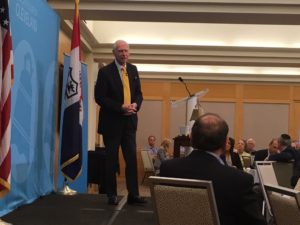
Christine Whitman, former Republican governor of New Jersey and former Administrator of the United States Environmental Protection Agency; Dr. David Orr, Professor of Environmental Studies and Politics at Oberlin College; and Shanelle Smith, Ohio State Director for the Trust for Public Land were the panelists at the City Club’s 2019 State of the Great Lakes presentation on Friday, June 21.
“The state of our democracy and the state of the earth are linked,” said Orr. We are not going to be able to solve our environmental problems unless we address our political problems.
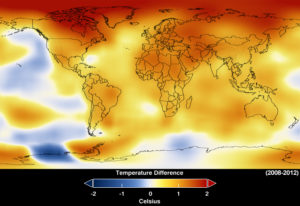
The more northern we look, the more Earth is warming, as shown by this NASA image. https://www.nasa.gov/topics/earth/features/2012-temps.html
America has made great progress in cleaning and protecting the environment in the past fifty years, said the panel. 1969 was a tipping point for America’s environment.
Awareness of the costs of unconstrained industrial pollution had been building since the 1962 publication of Rachel Carson’s book, Silent Spring. But a major oil spill in Santa Barbara, California in January 1969, and a fire on the Cuyahoga River in June of that year boosted public awareness and sparked a flurry of federal environmental legislation.
Within six months Congress passed the National Environmental Protection Act and before the end of 1974 Congress had created the Environmental Protection Agency, strengthened the Clean Air Act, and passed the Clean Water Act, the Endangered Species Act and the Safe Drinking Water Act.
Over the next decades dramatic progress was made in cleaning the nation’s air and water.
But that progress is now imperiled.
“We’ve made a lot of progress,” said former EPA Administrator Whitman. “But now we are starting to backslide.” The Trump administration’s large-scale rollback of environmental regulations is concerning. Whitman said she understood the need to review regulations to ensure their continued usefulness. “But to just do away with them because you don’t like them makes no sense.”
The early environmental acts were passed with the support of Democrats and Republicans and were signed by a Republican president, said Orr. “The environment wasn’t a partisan issue, it was a convergence issue, something that needed to be done.”
But now environmental regulations have become a partisan issue, he said. “Politically, we have to come together. This is the challenge of our time.”
Wittman said that the American public sees the importance of the issue, but the actions of the Trump administration are troubling. She called the refusal of Secretary of State Mike Pompeo to sign a final declaration at the Arctic Conference unless all references to climate change were removed “mind-boggling.” The Arctic, Wittman noted, is warming twice as fast as the rest of the planet.
“Without leadership from the top,” she said, “you are not going to get the necessary focus.”
Today, said Wittman, environmental issues like everything else, are viewed through a partisan political prism, not through a policy prism.
But while partisan differences are acute in Washington DC, said Orr, the American public is less divided on environmental issues than some people say. Polling data indicates that “Americans of both parties consistently support robust environmental policies. But the link between what we want as people, and what we get as policy is broken,” he said.
Whitman and Orr both believe that the 2020 election will be critical for the nation’s environment.
“This is the first election in my life when the environment will be a major issue,” said Whitman. “That is good.” She expects that the Green New Deal, proposed by Congressional Democrats, will spark significant debate.
“If we get an in-depth, intelligent discussion of what we need to do concerning the environment we will be where we need to be,” she said.
Orr said the upcoming election will determine if America’s politics are resilient enough to handle the crisis we are facing.
But citizens will need to force elected officials to address environmental issues, said the panelists. “Elected leaders won’t respond until the public demands it,” said Whitman, the former governor.
“Citizens need to make their voices heard,” said Smith.
So far, the public has not forced attention to the issues. “It is very difficult to get people to consider the cumulative impact of their individual behaviors,” said Whitman. “We need to get people together to agree that there is a problem, then we can start working together to solve it,”
Orr agreed that individual behavior is important. But the scale of the problem requires government action, as well. “The drivers of individual consumer behavior are conscience and public policy,” he said.
Many Americans do not appreciate the impact of the latest climate data, said Orr. “Citizens need to know their numbers.”
The latest data is alarming, said Orr. “If we were in an aircraft cockpit there would be warning lights flashing all over the place. But we don’t have a political warning system. We have a limited time to get a handle on this.”
We won’t be able to solve our environmental problems until we solve our political problems, said Orr. “This isn’t about making democracy great again. It’s about taking democracy to the next level, creating a democracy that works for everyone, democracy that is transparent, fair, decent, foresighted, and scientifically literate.”
“This process starts at the neighborhood level,” he concluded, “with us talking to each other.”
Global temperature anomalies averaged from 2008 through 2012
Recently, Cuyahoga County passed an ordinance that will reduce the use of single-use plastic bags by retailers.
This is an action that other communities have taken without causing any obvious harm. Many retailers in the county already have stopped offering plastic bags.
But that didn’t stop at least one local grocery store chain from opposing the ban.
That store defended their position in a website and Facebook post that was, to put it charitably, one-sided, misleading, and inaccurate. Their argument can summarized as follows:
Most experts believe that paper bags have an equal or greater negative impact on the environment.
Plastic bags account for less than 1% of all plastic waste.
Estimates suggest that 50% of all plastic grocery bags are used multiple times.
Paper bags cost 5 to 6 times more than plastic bags, which results in a 2 to 3 million dollar increase in our overall costs- an expense that many of our competitors in the online grocery retail and restaurant industry will not incur.
We responded with this:
As customers of your store we were deeply disappointed to read your misleading and self-serving post opposing Cuyahoga County’s recently-passed ban on plastic shopping bags.
While we certainly agree that the best practice would be for all shoppers to use re-useable bags, we were offended by your faulty rationale for opposing the ban. Many, if not all of your customers appreciate honesty and a commitment to the greater good from the organizations that they work with or patronize. Your opposition to this action demonstrates neither.
First, the purpose of the ban is not to reduce the “impact on the environment.” The purpose is much narrower: it is to reduce the amount of plastic that enters the environment, the food chain, and ultimately humans. Opposing efforts to reduce the use of plastics – which are now ubiquitous in the environment and are especially present in Lake Erie drinking water – because the manufacture of paper bags has an impact on the environment is truly an apples and oranges comparison. Paper bags are not persistent in the environment and, unlike plastic bags, every paper bag produced since 1935 is not still present somewhere in some form on the planet.
Dr. Sherri Mason, professor of chemistry at the State University of New York at Fredonia, has studied plastic loading in the Great Lakes since 2012. Last year at the Cleveland City Club she explained that the most recent sampling of Lake Erie found 46,000 bits of plastic per square kilometer of water, a higher concentration than found in any of the world’s oceans.
Second, while plastic bags may account for a very small percentage of plastic waste, that is not a reason to oppose action that will, even in a limited way, reduce the impact of plastic on our environment. Small changes in behavior over long periods of time can produce big changes in outcomes. Certainly, much larger efforts are needed to significantly reduce the amount of plastic waste in our environment. But this step, though small, is in the right direction and should not be opposed because it is not the cure for the entire problem.
Third, the fact that some percentage of plastic bags are reused is irrelevant. The concern about plastic bags are that plastic as a material is remarkably persistent and that plastic bags have long-term negative impacts on wildlife, the environment, and likely human health. In practice they are rarely recycled and their presence in the single stream recycling waste stream is problematic for recycling facilities. The harm that plastic bags cause is not reduced just because a bag is used two or three times before being discarded. The plastic used to create the bag will still be in the environment 10,000 years from now, regardless of how many times the bag was used.
But it was used three times. Photo: Ron Prendergast, Melbourne Zoo
Finally, your unsupported claim that the shift from plastic to paper bags will impose costs on you but not on your online competitors seems disingenuous. According to public reports, your store’s revenues in 2015 exceeded $500 million. A “2 to 3 million dollar” increase in your overall costs does not sound like a serious threat to the viability of the company. A grocery retailer that receives orders online and then delivers them has enormous cost penalties in the staff time it takes to fill the order (they are paying someone to do what your customers do for you for free) and deliver it (another service your customers provide to you for free). Are you seriously implying that this bag ban will erase your very significant cost advantage over online retailers?
Finally, many grocery retailers – including some of your competitors here in Cuyahoga County – have already stopped offering plastic bags. Other retailers here provide a small credit (5 cents is common) to customers who bring their own bags. Any loss of profitability that they have suffered as a result of their actions has not been apparent. If anything, this ban will level the playing field and reduce your competitive advantage, so it is perhaps clear why you are opposing it. The fact that your store has not taken proactive action regarding single-use plastic bags (and other forms of packaging) while others have is not a credit to your company. The fact that you now are actively opposing the ban is discouraging.
Plastic bags are not the most serious environmental issue that we face. But they are a convenience that has a surprisingly large potential for harm and they are something that we happily lived without for many decades and could easily live without in the future. This ban is a very small step, but it is a step in the right direction and it may help prepare the way for bigger, more impactful steps in the future.
Please take a moment to shift your focus from your own bottom line to the greater good and reconsider your opposition to this action.
Economic inequality is threatening to destroy capitalism in America, and the only people that can save capitalism are the people who are benefiting from it the most. That is the message of Peter Georgescu, Chairman Emeritus of the global marketing and advertising firm Young and Rubicon. Georgescu has written about his concerns in a book titled Capitalists Arise. Yesterday he spoke about his concerns at the Cleveland City Club.
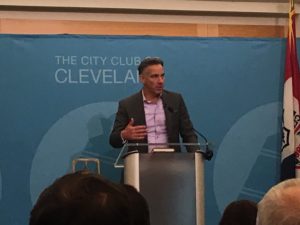
Peter Georgescu at the Cleveland City Club.
Free-market capitalism is the best system ever designed for creating wealth, he said. Capitalism has lifted billions of people out of abject poverty across the globe, created America’s middle class, and funded America’s rise as a great power. But the capitalist system that has done so much good is in peril. Not because of the lure of competing systems, but because of capitalism’s own failure to provide opportunity to all citizens.
“I am afraid we are going to kill the golden goose,” he said.
Today, capitalism works for just the top 20 percent of Americans, said Georgescu. “For the upper 20 percent of Americans, life is good.” he said. “But 70 to 80 percent of Americans are in deep trouble.” Sixty percent of Americans increase their debt load every year. They are functionally insolvent and are at risk for financial catastrophe if struck by an unexpected event, like loss of a job, high medical bills, or even an expensive auto repair.
Income inequality is exacerbated by the physical separation of American society into enclaves of prosperity and enclaves of poverty, co-existing side-by-side. “We have achieved complete success at segregating ourselves by income with disastrous consequences,’’ he said.
The result is a vicious cycle where residents of poorer neighborhoods suffer from increasingly poor services, fewer opportunities, and a loss of hope, while residents of prosperous neighborhoods are shielded from the impact of economic inequality.
The disastrous consequences for most Americans include bad schools, virtually no early childhood education, escalating consumer debt, few jobs, high unemployment, stagnant wages, drug and alcohol addiction, and a dramatic drop in life expectancy.
America’s low labor participation rate disguises the nation’s true level of unemployment, he said. “Unemployment in this country is not 3.7 percent,” said Georgescu. “That’s ridiculous. Look at the labor force participation rate, which is near historical highs.” People leave the labor force when they become discouraged. “People give up,” he said. “These are not lazy people; they are desperate people. That’s what the opiate crisis is all about.”
For forty years America’s system of free-enterprise capitalism generated wealth for most Americans, said Georgescu. Business received “humongous advantages” in the form of favorable tax rates, limited liability, and public investments in infrastructure and education. In return, business promised to behave like a good citizen by treating people fairly. Business leaders were committed to stakeholder capitalism, where the fruits of capitalism – profits – were shared with customers, employees, the corporation, shareholders, and society.
By following this simple model, American business worked magnificently, he said, providing wealth to a majority of Americans and strengthening the nation. “But today, that beautiful machine is in trouble.”
Beginning forty years ago, the focus of business shifted from socially responsible, long-term-focused stakeholder capitalism to a focus on one stakeholder: shareholders, to the exclusion of everything else, Georgescu said. Shareholder primacy has led companies to favor short-term profits over the long-term health of the corporation and society. As a result, businesses have reduced investments in employees, facilities, productivity, and society.
“The change from multiple stakeholders to shareholder primacy happened gradually, slowly over time, without a clear understanding of what the consequences would be,” he said. Most businesses now view employees as a cost to be lowered by holding down wages, limiting benefits, cutting training, and replacing workers with machines. “Instead of using technology to help people become more productive, we have used technology to get rid of people,” he said. “But these are the people that add value and generate productivity.”
The results have been disastrous.
“Signs of unrest are everywhere now,” he warned. “When an inequality crisis gets too severe, it solves itself in one of two ways: society redistributes wealth through taxation, or poverty gets redistributed through revolution.”
Nearly all CEOs that he has discussed this with agree with his analysis, he said, but they often don’t know what they can do. They fear they will be ousted by shareholders if they reduce shareholder rewards. But some companies are already moving away from shareholder primacy said Georgescu, citing Delta Airlines, Home Depot, Costco, Microsoft, Amazon, and Google as examples. These companies – and others – invest in research and they invest in long term outcomes, not short term. They are not perfect, but good, he said.
Business has a responsibility address inequality, he said, because business is primarily responsible for creating the problem. Government didn’t create this problem and government cannot solve it. Government can assist, but the heavy-lifting must be done by business.
What can business do? The starting point, he said, “is to reinvent the relationship between the corporation and employees. We cannot allow employees to be totally disregarded.” In addition, “business needs to be honest, fair, and just to all of society.” Business must act now and with urgency, he said. Business and government must collaborate to create a more just, more fair, and more productive society. Business must stand for human value, morality, and truth.
Who can make the changes necessary? Boards of directors, shareholders, banks, government, CEOs – all must pull together, he said. “But today’s CEOs must lead the change.”
“We know what to do,” said Georgescu. But it will not be easy. “It is hard going. We are working against the clock.”
For more information, see Capitalists Arise, by Peter Georgescu and David Dorsey; Berrett-Kohler Publishers, Inc.; Oakland, CA; 2017. https://petergeorgescu.com/books/capitalists-arise/
We are losing a war that most if us don’t even know we are fighting. That was the sobering message delivered by CNN Chief Foreign Affairs Correspondent Jim Sciutto at the Cleveland City Club yesterday.
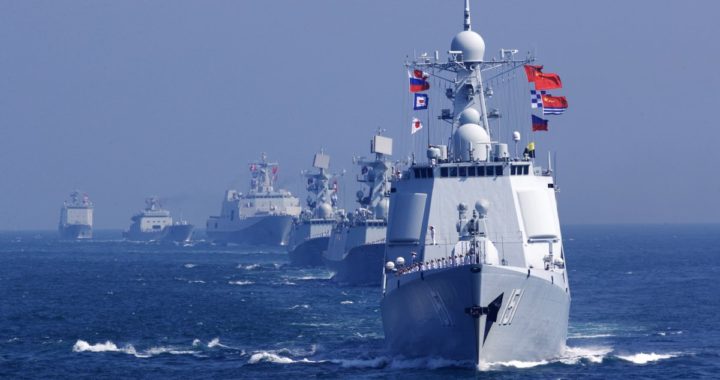
For three decades, China and Russia have been conducting carefully calibrated, disciplined, and effective campaigns to reduce America’s global power and influence, said Sciutto. Their tools have included cyber-attacks, theft of intellectual property, espionage, territorial acquisition, murders of dissidents, weapons in space, improvements in submarine technology, and increasingly aggressive military actions.
None of these efforts have been secret, said Sciutto. The Russian invasion of Ukraine, Chinese construction of military facilities on disputed islands in the South China Sea, Russian attempts to murder dissidents in London, Chinese theft of intellectual property, Russian interference in American elections and many other efforts are all well-known.
But the U.S. has responded to each incident as individual events, when, if fact, they were all elements of concerted and coordinated campaigns.
“We have failed to connect the dots,” said Sciutto. As a result, our responses have been ineffective. “We need to look at the full spectrum of Chinese and Russian actions.”
CNN Chief Foreign Correspondent Jim Sciutto at the Cleveland City Club
China and Russia are not conducting a joint campaign, said Sciutto. Their relationship is still marred by distrust, vast cultural and historic differences, and a long history of enmity. But they share an interest in rolling back U.S. power and influence, and they have adopted similar strategies. “If they see a convergence of interests,” he said, “they will cooperate.”
Both nations are pleased to see the United States retreat from global commitments, promises, and agreements. America’s withdrawal from Syria allowed Russia to increase its influence in the region and also gain access to a warm-water port on the Mediterranean Sea. America’s reluctance to confront China in the South China Sea has greatly strengthened China’s position there.
China and Russia have been careful to keep their actions below the threshold that would prompt an American military response, Sciutto said. The actions we have taken – warnings, sanctions, and military deployments – have not worked.
The United States has had ample evidence for years that Russia and China have been conducting deliberate campaigns aimed at reducing US power and influence, said Sciutto. But administrations from both parties, “have either ignored it or believed that their behavior will change over time.”
We have overlooked the significant differences between the United States and China and Russian, thinking they were more like us than they actually are, said Sciutto. In reality, their cultures, histories, economies, and politics are vastly different than ours. But we persisted in imagining that Russia and China want what we want, or that they will evolve to become more like us.
Not only has the U.S. response been ineffective, said Sciutto, but American leaders have not spoken out about Chinese and Russian attacks in a way that the American people can understand.
Today, U.S. government and military organizations recognize the growing threat from China and Russia and are taking positive steps, said Sciutto. But our failure to recognize the danger earlier has given both nations a head start. “We are way behind.”
Sciutto is not advocating a military response to Chinese and Russian non-military actions. But he believes that the United States must develop a coordinated, whole-of-government response that is based on a well-thought and considered strategy.
But even as American military and intelligence leaders are beginning to address the situation, the highest levels of the Trump administration continue to disbelieve or deny the threat, said Sciutto.
“We make it a heck of a lot easier for Russia and China by battling among ourselves, even in the face of incontrovertible evidence because some people see political advantage in denying Russia and China’s actions,” said Sciutto. “They do Russia’s work for them.”
Officials in U.S. military and intelligence agencies crave effective leadership from the top, said Sciutto. “They are not seeing it, and it is something we need to succeed.”
For a more detailed discussion, see Jim Sciutto’s book The Shadow War: Inside Russia’s and China’s Secret Operations to Defeat America; HarperCollins; New York; 2019.
This week’s tornadoes in Dayton and Celina should remind everyone in Greater Cleveland that urban areas are not immune from tornadoes.
Tornado damage at Fort Worth, TX, March 28, 2000. (Photo: http://www.weatherimagery.com )
While it is true that large cities are rarely stuck by tornadoes, that is not because developed areas are somehow resistant to the storms. The less-comforting reality is that cities are struck infrequently because they occupy a relatively small percentage of the land in tornado-prone areas. Unfortunately, as our urban areas continue to expand, the likelihood of developed areas being struck increases.
In many ways, urban areas are the worst places to be during severe tornadoes. With the exception of modern high-rise buildings, few city buildings are constructed to withstand tornado-force winds, and many commercial structures lack basements. More people outdoors when a storm hits will inevitably mean more injuries and deaths. Congested roadways make escape impossible and can prevent people in vehicles – who are extraordinarily vulnerable – from reaching shelter. Built-up areas will have much more debris than undeveloped areas, and most injuries and deaths from tornadoes are caused by flying debris. In densely-built urban areas nearby buildings may create wind-tunnel effects that actually increase the velocity of storm winds.
So, city and suburban residents should take a few moments to think about ways to protect themselves and their families from tornadoes.
The first thing to keep in mind is that during a severe tornado, except for the very centers of modern high-rise buildings, there is no place above ground that is safe. Tornado winds can reach 300 mph, and no residential structure in the United States can withstand those winds unless the structure has been specifically and expensively designed to do so. Such a building would probably be made of steel-reinforced concrete, with walls two-feet thick, with no windows, and with doors made of three-inch thick armor. And even then, it may not survive. The vast majority of existing buildings are designed to resist winds up to 120 mph or less, significantly lower than winds generated by EF-4 or EF-5 tornadoes.
Basements offer significant protection, but storm cellars are better. Best of all are basements equipped with specially-designed and well-constructed ‘safe rooms.’ The Federal Emergency Management Agency provides detailed instructions for designing and constructing ‘safe rooms’ for homes and small businesses. But specially-constructed ‘safe rooms’ can be expensive and very few homes or businesses have them today.
Without immediate access to a ‘safe room,’ here are some things you can do to increase your chances of surviving a tornado.
Do not risk your life attempting to film the storm on your smartphone. Searchers probably won’t find your phone anyway.
Get inside. The air will be filled with debris hurtling toward you at 100 mph or more. Most tornado fatalities are caused by flying debris.
Go to a basement or storm cellar. If there is no basement available, go to a small, interior room on the lowest level.
Stay away from windows, doors, and outside walls. Cover your head and neck with your arms. Cover yourself with blankets or coats. Put on a helmet if you have one.
If there is no basement and no small, Interior room, get under the heaviest desk, table, or other piece of furniture that you can find. This isn’t good, but it might be the best you can do.
If you are outside and cannot make it to a sturdy building, lie down in the lowest place you can find and cover your head with your arms. Cover your body with a coat or blanket if you can.
If you are in a vehicle and see a tornado, get out of your car immediately. Do not try to outrun it. Tornadoes can be fast, they change direction erratically, and they can throw large pieces of debris long distances. Seek shelter in a sturdy building or in a ditch or other depression. Do not park under an overpass or bridge.
The most important thing you can do is think about your actions now, before the tornado emergency is issued. Have an idea where you will go and how you will protect yourself. Your local fire department and your county’s emergency management agency can provide more information on tornado safety.
Originally published in the Cleveland Plain Dealer.
Want to know how best to commemorate the sacrifices American military personnel on Memorial Day – and every other day? Here’s a poignant and thoughtful suggestion from a combat veteran, as shared in a social media post by Jake Trapper of CNN:
As a
brand-new county EMA director I was eager to work with the fifty-nine political
subdivisions in my county to create a create an outstanding county-wide
emergency management organization. I
knew that fire chiefs, police chiefs, and service directors would all play key
roles and my agency already had identified liaison officers within each
community.
But I also
expected that elected officials would have a baseline understanding of
emergency management. Before engaging with any of these officials, I asked the
state EMA what emergency management training or information they provided to
newly-elected mayors and legislators. Since our state’s revised code required
each political subdivision to fulfill certain emergency management
requirements, I expected that someone, somewhere had provided that information
– as well as some additional background information – to these officials. I was
wrong.
While some
mayors were familiar with emergency management, and a few were even conversant
in it, most had no idea how our agency operated, what their responsibilities
were, and how their community would be supported if disaster struck.
We immediately put together an educational
program for elected officials consisting of office visits, e-mail updates, a
newsletter, and a handbook titled Emergency Management for Elected Officials.
But it wasn’t
only suburban mayors that had little awareness of what we were trying to do. I
found that in general most people – including many senior leaders in my own
county government – had little or no understanding of how emergency management
would work in the county in the event of a major disaster.
As a director I found that general lack of understanding to be a significant obstacle over and over again, and I realized that public outreach was a lot more involved than the make-a-plan, build-a-kit mantra that we were accustomed to providing. Emergency managers can’t count on other people taking the time to learn about emergency management. They need to do everything they can to inform the community, create a sense of urgency, and encourage collaboration.
Across the street from Cleveland’s Progressive Field lies one of the lastsurviving remnants of the city’s early history. The Erie Street Cemetery, established in 1826 when the city’s population had not yet reached one thousand, is an 8.9-acre rectangle of green within the slightly gritty edge of the downtown business district.
A grey sandstone arch, inexplicably Gothic, crowns the cemetery’s entrance and the perimeter of the grounds are marked by a time and soot-darkened stone wall. Inactive as a cemetery for decades, but unlocked each day by the city, a visit to the cemetery provides the quintessential Cleveland experience: a dizzying combination of rich history, neglect, resilience, and unfulfilled potential.
For 25 years after the arrival of the first hardy settlers, burials in the village were conducted at an undeveloped parcel near Public Square. But in 1825, as the city population was increasing, the owner of the property made plans to build on the site and forbade further burials. The village then purchased a ten-acre tract on Erie Street, that was, at the time, so far out of town that some villagers complained.
Purchase price for the ten acres was one dollar, which indicates how valuable Cleveland real estate was at that early date. Of course, today the city land bank will sell you an abandoned city lot for $200, and as recently as 2009 the city sold more than 100 foreclosed homes for $1 each, so property bargains are still available.
For the next fifteen years Erie Street Cemetery was the city’s only cemetery and many of the community’s most notable early residents were – and remain – buried there.
It is necessary to note that many remain, because internment in those early years was sometimes less than permanent.
The first residents of the Erie Street Cemetery were actually prior residents of the informal burial ground near Public Square. They were evicted to make way for progress and they found themselves parked in two long lines just inside the new cemetery’s main entrance. A monument listing the names of some of those wanderers can still be seen in the cemetery.
For many decades Erie Street remained a popular destination for persons in need of its specialized services. It was near the center of the growing city and was well-maintained. In 1870 the city surrounded the cemetery with an iron fence and constructed a monumental stone arch over the main entrance on Erie Street – now called East Ninth Street.
The fence is long gone, replaced by a stone wall built of sandstone blocks recovered during the 1939 razing of a portion of the Superior Viaduct – the first high-level bridge to cross the Cuyahoga River – but the arch remains.
By the turn of the new century, however, Erie Street had fallen on hard times, and many residents were moved to newer cemeteries in outlying neighborhoods. By then, city officials saw the cemetery as a waste of developable land in the heart of the city and they began to buy vacant plots to discourage further burials. Eventually, they sold off portions of the cemetery to allow creation of new streets, forcing the eviction of many long-time residents who had probably expected to remain there somewhat longer. Even the original owner of the land, Leonard Case, and his family were moved to the city’s more upscale Lakeview Cemetery.
In the 1920’s as plans were being formulated to construct the Lorain-Carnegie bridge (since renamed the Hope Memorial Bridge), city officials proposed routing the bridge approaches through the center of the cemetery. But that idea, like a 1960’s proposal to build an interstate highway through the middle of the verdant Shaker Lakes, failed and since then the city has apparently abandoned the idea of converting the cemetery to other uses. For now, at least, Erie Street residents can rest in peace.
They certainly are not at risk of being disturbed by city maintenance crews. Today the cemetery is, how can we say it, slightly unkempt. The unpaved roadway is uneven and many headstones are broken or overgrown with grass or weeds. Damaged trees are common and several large trees are clearly dead. Although a sign hopefully provides headstone and decorating guidelines, few persons seem inspired to decorate any of the thousands of graves.
Such neglect is disrespectful toward anyone, but it is especially discouraging considering the important roles played in the city’s early development by some of the folks still buried there.
Most prominent, perhaps, is Lorenzo Carter, the first permanent resident of Cleveland and for a time quite possibly the busiest white man west of the Appalachian Mountains. Carter died in 1814 at age 47, but before then he built a large log cabin which served as an inn and a jail; he operated a ferry to take travelers across the river; he built the city’s first tavern; he built a 30-ton schooner, the Zephyr; he built the first frame house in Cleveland and the first log warehouse in the city; and he served as the village constable and as a major in the Ohio Militia. As if that wasn’t enough, in his spare time he and his wife, Rebecca, produced nine children.
But don’t look for a handsome monument to the city’s most energetic founder. Lorenzo Carter is buried – reburied, actually, since he died before the cemetery was established – with Rebecca under weathered stones set in a deteriorating concrete slab a few paces inside the cemetery gates.
None of the early city notables who remain at Erie Street fare much better. Scattered around the site are four Cleveland mayors, two Indian chiefs, and 168 military veterans from the Revolutionary War, the War of 1812, the Civil War, and the Spanish-American War. But none of their graves are maintained especially well, and no signs or markers help visitors find them.
If there are visitors. Certainly, the place is exceedingly ill-equipped to handle them. Besides the lack of signs, the cemetery has no benches, landscaping, curving paths or memorial gardens. There is not even a flagpole.
But the cemetery – and its residents – have not been completely forgotten. In 2005 the Early Settle’s Association replaced a vandalized bronze plaque commemorating the Carters with a granite marker. In 2013 the city paid a contractor to refurbish the entrance gatehouse and arch, and in 2014 the Early Settlers erected a monument to the cemetery’s veterans.
Like the city itself, the Erie Street Cemetery has seen good times and bad, but somehow, it keeps plugging away.
War is hard, especially if you have to learn on the job. But that was the task American and Japanese
naval officers faced in May 1942, as they fought the world’s first carrier
versus carrier naval battle in the Coral Sea.
Usually described as a tactical victory for Japan but a
strategic victory for the allies, the Battle of the Coral Sea can only be
evaluated as one part of the year-long allied campaign to halt Japanese
expansion – a campaign that included the American carrier raid on Rabaul in
April 1942, the Battle of the Coral Sea in May 1942, the Battle of Midway in
June 1942, and the invasion of Guadalcanal in August 1942.
That campaign – conducted primarily by American forces but
including support from Australian surface ships, aircraft, and ground troops –
stopped the Japanese advance, changed the character of the Pacific War, and,
more importantly, sealed Japan’s fate.
Japan had but one chance to survive war against America and
Britain. She somehow had to force
America to give up the struggle while she herself was still intact. If the war
was prolonged Japan stood no chance of overcoming America’s vast industrial
capacity. In mid-1941, as Japanese naval leaders were putting the finishing
touches on their plans to attack Pearl Harbor, the United States Navy and the
Imperial Japanese Navy were nearly equal in strength. But while the Japanese
had an additional three battleships, seven aircraft carriers, and five cruisers
under construction, the U. S. Navy was building 17 battleships, 12 Essex-class
aircraft carriers, 54 cruisers, 197 destroyers, 74 submarines and many hundreds
of auxiliary ships, minesweepers, and small escort-type vessels.
America’s naval construction program was no secret. Japanese
strategists knew that by 1944, when this building program was complete, Japan,
its empire, and the whole East Asia Co-Prosperity Sphere would be annihilated, as
long as America maintained the will to do so.
Admiral Yamamoto knew it. He famously said before Pearl Harbor
that if Japan attacked America, it would win victories for six months to a year,
but after that, he had no confidence.
Winston Churchill knew it. In his six-volume history of the war
he wrote that upon hearing of the Pearl Harbor attack, his first thoughts were
that victory over Germany and Japan was assured and that Japan “would be ground
to a powder.”
So, Japan’s only hope was to break America’s will at the outset
of the war. They hoped to do this by smashing the Pacific Fleet in a decisive
battle, driving the survivors back to the West Coast, while constructing a vast
interconnected network of island airbases (unsinkable carriers) that would make
any U. S. counter-offensive so costly that America would lose heart and negotiate
a peace that preserved the empire and Japan.
Thus, having secured their initial objectives in a series of lightning conquests in Malaysia and Indonesia, in early 1942 Japan attempted to create a major air base at Rabaul, cut American supply lines to Australia by seizing Port Moresby, lure the U.S. fleet into a decisive battle at Midway, and strengthen their defenses by building an airbase on Guadalcanal.
In the end, all four Japanese efforts failed. Rabaul was neutralized as an airbase by American carrier raids; the invasion of Port Moresby was turned back at Coral Sea; Midway was a decisive defeat for Japan; and the United States seized Guadalcanal’s valuable airstrip before the Japanese could finish it.
Here are a few significant facts about the Battle of the Coral
Sea:
It was fought by pre-war forces.
Before Coral Sea, neither side had lost an aircraft carrier in
the Pacific War, although Japanese carrier aircraft had sunk the HMS Hermes
in the Indian Ocean in April 1942. The U.S. had lost the bulk of its pre-war
battleship fleet at Pearl Harbor, but pre-war battleships were unsuitable as
carrier escorts and did not participate at Coral Sea for either side. Japan
employed three carriers at Coral Sea, while the United States deployed two, but
the striking power of the fleets was almost identical as the three Japanese
carriers had 127 planes while the two U.S. carriers had 128. The results of the battle reflected the
pre-war training, professionalism, and preparation of Japanese and American
pilots. Japanese pilots had an advantage in training and combat experience and
they outperformed their American opponents.
It was the first carrier-carrier battle, and no one knew how to
fight it.
At Coral Sea neither side understood the best tactical formation
for protecting their carriers. Later in the war both sides understood that concentrating
carriers and escorts to achieve massed defensive fire was the best course of
action, but at Coral Sea neither side effectively massed its firepower.
During the two days of air strikes at Coral Sea, neither side
was able to coordinate its attacks. U.S. bombers and torpedo planes did conduct
simultaneous attacks against Shoho on the first day, but that coordination
was unplanned and accidental. On the second day USS Yorktown dive bombers and
torpedo bombers did conduct a coordinated attack against At Midway, one month
later, the U.S. would again fail to coordinate its strikes.
Both sides suffered from inaccurate scouting reports and
exaggerated and conflicting damage reports from pilots. Again, and again, scout
planes inaccurately reported the location and disposition of enemy forces. This
was a problem throughout the war, but at this early stage, naval leaders did
not realize that the wildly inflated damage claims made by pilots were, in
fact, erroneous. War is hard enough when the fragments of information available
to commanders are accurate. It is nearly impossible when the only information
commanders get is wrong. Throughout the
battle Japanese and American commanders didn’t know who they were attacking, or
how much damage their strikes had inflicted.
The air groups of both sides had too many strike planes and too
few fighters to mount an effective defense. This would be corrected later in
the war.
The outcome was unexpected
Pre-war doctrine had assumed that lightly built carriers could
not survive a strike by aircraft. That belief was reinforced by the destruction
of the heavily-armored and stoutly constructed warships HMS Repulse and HMSPrince of Wales off Malaysia in December 1942 and the destruction of the
British aircraft carrier HMS Hermes in April 1942.
But three of the five carriers attacked at Coral Sea survived,
and one – USS Yorktown – played a key role in the battle of Midway one
month later. Carriers could be hit by dive bombers, but damage from above was
unlikely to disable their engines or breach their hulls. Torpedoes were far
more destructive to carriers, but torpedo attacks were more difficult to carry off.
Carriers were most vulnerable when fueled and armed aircraft were caught on
board, as the Japanese would learn to their sorrow at Midway.
The battle was badly managed by both sides
Naval commanders from both nations had a lot to learn about
managing the carrier air war.
Compared to surface combat, air war required fast – almost
instantaneous – decision-making, while the battle space had expanded enormously. Japanese commanders compounded their own problems
by directing their forces from ashore at Rabaul, while the American forces were
commanded by ADM Fletcher aboard USS Yorktown.
Neither side managed to strike their primary target on the first
day. Both launched strikes against secondary targets due to target
misidentification.
Although the U.S. carriers were equipped with radar, their crews
were inexperienced and had difficulty vectoring defending fighters to the
correct altitude against Japanese strikes.
The United States allowed its only oiler to be destroyed,
severely limiting their ability to operate for extended periods. With USS
Neosho gone, U.S. ships could operate only as long as they had fuel, which
would be a few days at most.
It influenced the battle of Midway, perhaps decisively
At Coral Sea Japan lost the use of three aircraft carriers that
had already been assigned to the Midway operation force. The loss of these ships
and their aircraft significantly reduced the Japanese advantage at Midway and
likely contributed to the Japanese defeat.
The loss of carrier pilots at Coral Sea was far more damaging to
Japan than the loss of flight decks.
Japanese pilot losses were heavy in the opening months of the
war and Coral Sea and Midway cost Japanese naval aviation another 200 skilled
and experienced pilots. Japan had
started the war with more than 2,000 trained naval aviators, so the loss of 200
pilots need not have been disastrous. But Japan never developed a system for
training replacement pilots, so losses at Coral Sea, Midway, Eastern Solomons,
and Santa Cruz crippled Japanese naval aviation for the remainder of the war.
Before the war Japanese carrier pilots averaged more than 800
hours of flying time, with some exceeding 2,000 hours. By early 1943, Japan was
sending replacement pilots to the fleet who had fewer than 150 hours of
experience. In the words of British military historian H. P. Wilmot, sending
such inexperienced fliers into combat, “was tantamount to a death sentence.”
Code breaking greatly assisted U.S. forces
While codebreaking’s role in the U.S. victory at Midway is widely celebrated, codebreaking’s role at Coral Sea is less well-known. U.S. codebreakers had penetrated the Japanese naval code JN-25 in April 1942 and were able to read as much as 85 percent of signals. Of course, they could only read what the Japanese transmitted, and not all of that, so the information gained was fragmentary at best. But signals analysis, intuition developed through long experience, and fragments obtained by codebreaking – abetted by Japanese carelessness – convinced the Americans that the Japanese were planning an operation in the Southwest Pacific. Forewarned, the Americans were able to send carrier forces to the Coral Sea before the Japanese arrived.
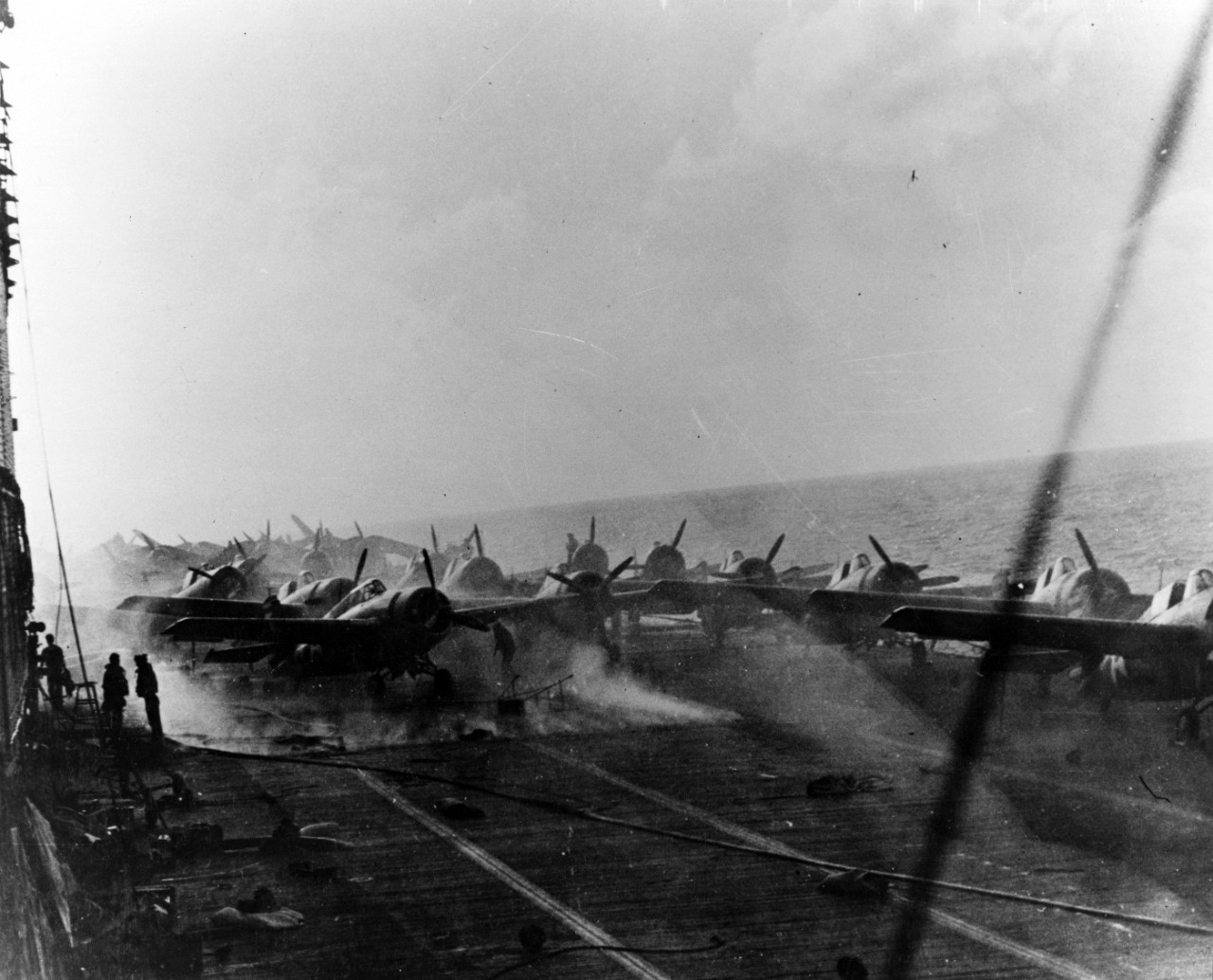
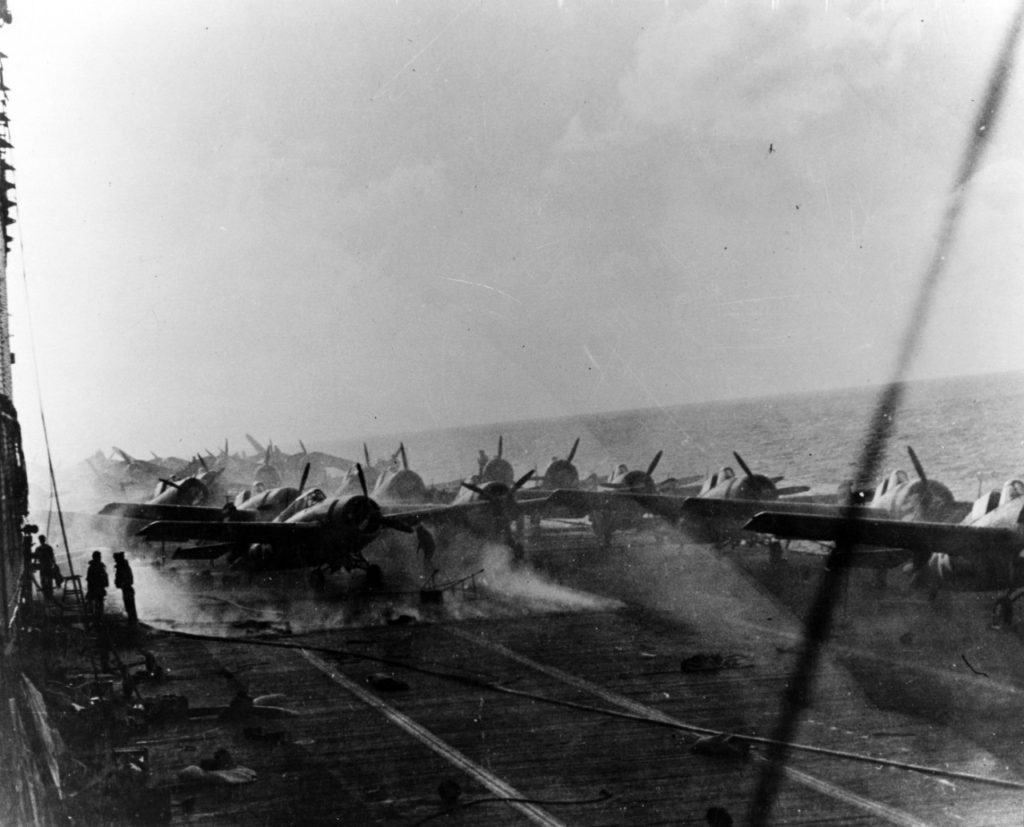
View on the flight deck of USS Lexington (CV-2), at about 1500 hrs. on 8 May 1942, during the Battle of the Coral Sea. The ship’s air group is spotted aft, with Grumman F4F-3 fighters nearest the camera. SBD scout bombers and TBD-1 torpedo planes are parked further aft. Smoke is rising around the after aircraft elevator from fires burning in the hangar. Note fire hose, wheels, propellers, servicing stands and other gear scattered on the flight deck. Official U.S. Navy Photograph, now in the collections of the National Archives. Catalog #: 80-G-16802
For a detailed discussion of the Battle of the Coral Sea, see: H. P. Willmott’s The Barrier and the Javelin: Japanese and Allied Pacific Strategies February to June 1942; Naval Institute Press, Annapolis, MD; 1983. https://www.usni.org/press/books/barrier-and-javelin