“There will be a day sometime in the near future when this guide will not have to be published. That is when we as a race will have equal rights and privileges in the United States.” – Victor Hugo Green

Victor Hugo Green in 1956
Later this year a film titled “The Green Book” will be coming out. I don’t know much about the film, but I know a little about the Green Book.
The Green Book was a travel guide published by an African-American post office employee named Victor Hugo Green. He first published the book in 1936 to help black Americans find gas stations, restaurants, and hotels that would actually serve them. While legal segregation (Jim Crow laws) was more prevalent across the south, many businesses in the north also refused to serve blacks.
It didn’t matter if you were a teacher, a pastor, a nurse, or a combat veteran. Until the Civil Rights Act was passed in 1964, if you were a black American, you would be denied access to services all across the country. Black travelers had to plot their route across the states like military logisticians planning a campaign: ‘Here’s where we can get gas, and then, just up the road here we can get a meal. We’ll have to leave the main road here and backtrack a bit to get a room, but we’ll be able to get breakfast just past here…’
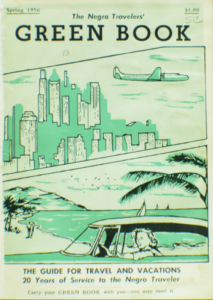
The Green Book, 1956 edition
A visitor from a distant place – Finland, maybe, or Mars – might wonder what these poor souls had done to deserve being treated like that. The answer, of course, would be, “Nothing.”
Well, we’ve made a lot of progress in race relations in this country. Been a while since lynchings were grand public spectacles. But we’ve still got a ways to go.
An article by writer Amber Ruffin, a black American who is married to a white man from the Netherlands, gives a little insight into the state of race relations today. “When you’re young and black,” she writes, “it seems like your parents are obsessed with racism. You think it can’t possibly be as crazy as they think it is. But then you get older and see they were not exaggerating. Jan never thought I was exaggerating—I had a real fear that he might—but he didn’t fully understand the consequences of discrimination until he saw them.”
To read Ms. Ruffin’s article, click here: https://www.glamour.com/story/amber-ruffin-on-being-in-an-interacial-relationship
For more information about Victor Hugo Green and the Green Book, click here: https://en.wikipedia.org/wiki/Victor_Hugo_Green
(Photos from Wikipedia)
September 24, 2018
 Just returned from a week in London, where our daughter will be attending university.
 The city is more crowded and diverse than I expected. Of the two, the crowds were more surprising. Shopping districts, museums, and parks all seem to be well-attended. At times, they are uncomfortably crowded. Not exactly sure why I didn’t expect the city to be crowded, as it was the most populous city on earth from 1831 until 1925. Today, it has more international arrivals each year than any other city. As for diversity, well, London was the center of a world-wide empire for hundreds of years, so it has always drawn migrants, immigrants, visitors, merchants, financiers, and government officials from all over the planet. While the empire is no more, London has remained one of the most accessible and open of the world’s great cities.
 “Aesthetically speaking, London is just beautiful; it’s a gorgeous city. The architecture, the monuments, the parks, the small streets – it’s an incredible place to be.” – Sara Bareilles