Elephants

Adult elephants stand guard while young elephants rest in the shade. Photo by Carl Safina: http://beyond-words.net/

The Trump administration is considering elimination of a ban on importation of elephant “trophies.”  Administration officials have offered a somewhat dubious rationale that the fees paid by hunters will support elephant conservation efforts.  This seems unlikely, as the amount of revenue expected to be raised is a tiny fraction of the cost of conservation.  Some thoughts:

  1. Getting on a plane and flying to Africa to kill large endangered mammals (and make no mistake, pretty much all of the wildlife in Africa is endangered or at least imperiled by habitat loss, agricultural development, and poaching.) with a high-powered weapon from a safe distance seems unsporting and remarkably thoughtless. I suppose I would ask a “trophy hunter,” what did that animal ever do to you? Can you make an elephant?  If not, what gives you the right to destroy one?
  2. These “trophy animals” aren’t paper or plastic targets. Why should they be subjected to pain, distress, and death for some hunters’ momentary excitement?
  3. Elephants, especially, are intelligent, social animals that communicate with each other, assist each other, take pleasure in the company of others, and grieve the loss of others. Here are some facts about elephants:
  • The basic unit of elephant society is a female and her children.
  • Elephant families share infant care and child-rearing.
  • Elephants maintain extensive social networks, recognizing and communicating with family members and members of other families who live nearby.
  • Even in times of distress and danger, elephants behave with kindness and tolerance to their own kind, and maintain family ties.
  • Elephants gain status through age. Experience that comes with age determines the survival of elephant families.
  • Death of an elephant matriarch threatens the well-being and survival of the entire family unit.

For a thoughtful and riveting account of elephant society, see Beyond Words, by Carl Safina (Holt and Company, NY, 2015).

November 18, 2017
Notes from London

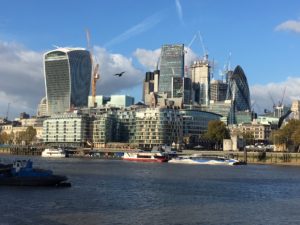
London Skyline WITH Modern office towers

Just returned from a week-long visit to London. Here are six quick impressions:

  1. The public transit system is efficient and effective. The region-wide system includes a combination of subways, surface trains, buses, taxis, and passenger ferries and it reaches all sectors of the metropolitan area. We used surface trains and subways on this trip and we found the trains and stations to be clean, well-lighted, well maintained, and easy to use. We purchased re-fillable fare cards, called Oyster Cards, before we left home and the cards were convenient and easy to “top-up” with additional money at fare machines located at every station. Signage throughout the rail systems was abundant and easy to understand.
  2. The population of London is diverse and cosmopolitan, and Londoners take pride in the way all ethnic, religious, and racial groups get along. As our visit was limited to central London and some western boroughs, we cannot say that there aren’t problems in some areas, but we never got a sense that there were significant ethnic, religious, or racial issues. I would guess that the tolerant atmosphere is at least partially a result of the city’s long history as the center of a world-wide empire.
  3. The city is more crowded than we expected. Streets and sidewalks were frequently jammed with pedestrians and there was never a time when there weren’t other people around.
  4. Green Park

    New construction and renovations are occurring all over the city. A few buildings here and there are in poor repair, but with the population rising and property values soaring, we do not recall seeing any vacant buildings or lots.

  5. The large city parks – St. James Park, Hyde Park, Richmond Park, Bushy Park, Green Park, etc. – are enormous. Many were originally established as private hunting preserves for the royal family, but today they are open to all, are well-maintained, and are very popular.  As a center of history and culture, few urban centers can rival London, so spending a day or two in the parks might seem like an opportunity wasted; we have trees at home, after all.  But the parks are quintessentially British, and they are historic in their own right, so I would encourage visitors to spend some time there.
  6. As is so often the case while traveling internationally, plenty of folks we encountered spoke English, so our traditional American unfamiliarity with the local language and customs was no problem at all.

November 18, 2017

Wooden Ships and Iron Men

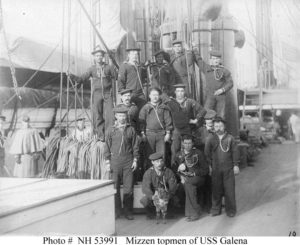
Crewmen of USS Galena (U.S. Naval Historical Center Photograph)

A small slice of naval history to commemorate the 242nd birthday of the U.S. Navy. It’s pretty hard to find a single image that fully expresses the heritage, history, complexity, and essence of the United States Navy, but any photo that highlights the dedicated sailors that have served through the years is a good place to start. (And no, I am not actually in the photo…)

October 13, 2017

Here’s Why Puerto Rico Needs an Urgent and Comprehensive Federal Response

The combination of widespread power outages, the inability of relief teams and emergency supplies to travel overland to the island, and the inability of residents to self-evacuate to nearby unaffected areas make the humanitarian disaster in Puerto Rico and the Virgin Islands unprecedented in U.S. history. When local officials ask for federal help, they are not being greedy or lazy. It is what they are supposed to do.

Here are seven reasons why Puerto Rico needs an urgent and comprehensive federal response to Hurricane Maria:

  1. The National Response Framework (NRF) – which applies to local, state, and federal governments (including territories like Puerto Rico) – established a tiered response system in which disasters are managed by the lowest level of government whenever possible but also provides for support from other levels when necessary.
  2. By creating a tiered system in which larger, more capable entities (state and federal governments) support local governments, the NRF allowed a more efficient use of resources, as critical capabilities could be shared widely.
  3. Under the NRF, neither territories (like Puerto Rico) nor municipalities (like San Juan) are expected to be self-sufficient in the wake of major disasters. The Framework anticipates that local communities and states will seek and receive assistance from neighboring communities and states before significant federal assistance can be provided. Houston, Texas, – a far larger and wealthier city than San Juan – received immediate assistance from Texas, from other states, from the federal government, and from countless private sector organizations in the wake of Hurricane Harvey. Unfortunately, Puerto Rico has no neighboring states and private sector aid cannot easily reach the island, placing a greater burden on the federal government.
  4. An extended power outage is the worst-case scenario for natural disasters. Loss of power complicates every aspect of emergency management and exponentially increases the number of persons who need emergency assistance. While many critical facilities (hospitals, police stations, communications centers, major financial institutions, etc.) will have their own back-up power sources; transportation systems, commercial food storage and distribution systems, civilian communications systems, nursing homes, clinics, schools, and high-rise apartment buildings typically will not. Persons dependent on home medical equipment (oxygen concentrators, home dialysis units, etc.), elevators, and other electrically-powered devices are at serious risk and may need immediate assistance.
  5. As an island, Puerto Rico is physically cut off from the the vast machinery of emergency management that exists in the continental United States. When hurricanes or tornadoes cause widespread power outages in Florida, Texas, or other U.S. states, electric utility companies from across the U.S. immediately deploy convoys of crews and equipment to the affected area to assist in restoring power as soon as possible.  Restoring power after a wind event requires repairs to thousands of individual downed lines and damaged transformers. No electric company anywhere is equipped to repair thousands of breaks without massive outside assistance.
  6. The requirement for on-the-ground assistance in Puerto Rico dwarfs any other disaster in American history. More than three million people are trapped on an island with limited power, limited food, limited water, and limited medical care.  Unlike disasters in the continental U.S., no one can hop in the car and drive to a motel, or a relative’s house, or a shelter in a neighboring state. Likewise, aid workers and providers of emergency supplies are severely restricted in their ability to get to the island.  The fleets of trucks from Wal-Mart and other donor companies that are common sights at U.S. disasters aren’t bringing bottled water and other emergency supplies to Puerto Rico.
  7. The NRF does not require that local communities prove their worthiness for assistance. It assumes that Americans will help Americans, regardless of political affiliation, religion, race, or any other factor. When local officials ask for federal help, they are not being greedy or lazy.  It is what they are supposed to do.

September 30,2017

Fourteen Facts About Kamikazes You May Not Know

  1. The first organized Kamikaze attacks were conducted on October 25, 1944. Before that individual pilots had sometimes crashed damaged aircraft onto American ships, but suicide attacks by specially trained and organized “Special Attack” groups did not occur until the war had turned very badly for the Japanese.
  2. The Japanese resorted to organized suicide attacks when the United States captured islands within bomber range of Japan and the Japanese Navy was almost completely destroyed.
  3. The Japanese hoped that mass suicide attacks against U.S. Navy ships would discourage Americans and compel the U.S. government to negotiate a peace settlement that would avert a U.S. invasion of Japan and allow Japan to keep some of its war gains.
  4. Inaccurate, wildly exaggerated claims of success following the initial kamikaze attacks led Japanese military leaders to continue and expand the use of the tactic.
  5. Japanese Kamikaze pilots were not all volunteers. While the earliest kamikaze pilots were experienced airmen who did volunteer, once the supply of pilots was exhausted Japan resorted to coercion and eventually to drafting university students and assigning them to suicide units.
  6. Kamikaze attacks were coordinated and well-planned. Special Attack Units were formed and pilots were trained specifically to crash-dive onto Allied ships. Mass kamikaze attacks were essential elements of Japanese plans for the defense of Okinawa and mainland Japan.
  7. Kamikaze attacks were five times more likely to result in damage to a U.S. ship than conventional air attacks.
  8. Mass suicide attacks were a surprise to many American military planners, although some analysts and planners had foreseen the tactic.
  9. Kamikaze attacks were launched from airfields ashore. No kamikaze missions were flown from Japanese aircraft carriers.
  10. Kamikaze pilots were permitted to return to their base if they were unable to locate a suitable target.
  11. Most of the damage caused by Kamikaze attacks was the result of the bombs the aircraft carried, not from the crash of the actual aircraft.
  12. The Japanese developed and continually refined detailed tactics for suicide attacks. Designated observer planes often accompanied suicide attackers to report the results of the attacks to Japanese planners.
  13. In addition to suicide crashes by conventional aircraft, the Japanese employed suicide attacks by rocket planes (Ohka), small boats, manned torpedoes, and large warships.
  14. The Japanese held more than 10,000 aircraft in reserve for suicide attacks during the expected invasion of Japan.

September 28, 2017

Nothing Says ‘Land of the Free’ Like Forcing People to Stand for the National Anthem

111207-N-DX615-028
PHILIPPINE SEA (Dec. 7, 2011) A flag detail aboard the amphibious dock landing ship USS Pearl Harbor (LSD 52) renders honors during a remembrance ceremony for the Dec. 7, 1941 attack on the ship’s namesake, Pearl Harbor. Pearl Harbor and embarked Marines of the 11th Marine Expeditionary Unit (11th MEU) are on deployment conducting operations in the U.S. 7th Fleet area of responsibility as part of the Makin Island Amphibious Ready Group. (U.S. Navy photo by Mass Communication Specialist 2nd Class Alan Gragg/Released)

Well, I guess there is something wrong with me. Even though I served 22 years on active duty in the U.S. military (including a year in Iraq) and another nine years as a police officer, somehow I feel neither disrespected, diminished, insulted, nor devalued by the modest and dignified actions of some NFL players. They didn’t yell at anybody, they didn’t threaten anybody, they didn’t break anything. Nobody missed a meal or lost their health insurance because some football players didn’t follow the customary procedure before kickoff. They didn’t even delay the start of the games. I have read their explanations of why they acted and they have been unfailingly respectful of the sacrifices of military and public safety personnel. They simply tried to draw momentary attention to an injustice that they see every day. This is their right under the United States Constitution, a governing document that I promised to defend numerous times in my military and law enforcement careers.
Unfortunately, the original message has long since been drowned out by a cascading torrent of overreaction and unhelpful vitriol. As this thing heated up, my initial reaction was pretty much “Nothing says ‘Land of the Free’ like forcing people to stand for the national anthem.” Now my reaction is just a dull sadness that people are so easily provoked into hateful and hurtful comments.
I like the flag, but I like the Constitution even more. The silent protests before football games haven’t diminished my pride in my service or interfered with my life, liberty or pursuit of happiness. If anything, the protests have reaffirmed my faith in America and its people. We are a better nation when citizens who see an injustice are willing to stand up and say, “This is not acceptable.”

September 25, 2017

U.S. Astronaut Pens Open Post to President Trump

A heartfelt post from U.S. astronaut Leland Melvin, who is also a former NFL player. The post is a little long but it makes several significant points, including the disheartening willingness of the president and his administration to validate and encourage white supremacist extremists; the value of taking an “Orbital perspective” which recognizes Earth as a fragile and threatened home that we all share regardless of artificial and transient political boundaries; and the critical responsibility of a president to unify the nation through dignified, compassionate, and respectful behavior.

“Looking back at our planet from space really helps one get a bigger perspective on how petty and divisive we can be.”

September 24, 2017

To Donald TrumpI believe in the Declaration of Independence and the Constitution of this country even though at the…

Posted by Leland Melvin on Saturday, September 23, 2017

The Machine Theory of Economics

Every day the news is filled with articles tracking, predicting, or misrepresenting the current state of the U.S. economy.  Many of these articles and posts are written with a jaunty confidence that seems to imply that the author actually understands the workings of the American economy.  Don’t fall for that nonsense.

The American economy is a massive, unplanned, uncoordinated, uncontrollable contraption that has been assembled by an uncountable gaggle of geniuses and idiots through three centuries of trial, error, invention, innovation, obsolescence, and political opportunism. While some economists understand specific elements of the economy, like the labor participation rate or the completely mythical Laffer Curve, no one understands the entire construct.  These subject matter experts are like auto mechanics who know all there is to know about fuel pumps, but who have never seen an actual automobile.

This is not to demean economists, many of whom are capable of leading normal lives. Their task is beyond Herculean. Economic activity is every activity. Get up in the morning, don’t get up.  Go to work, don’t go to work. Read a book, watch cable news, eat a grape, walk the dog, buy a house: every act, every decision, has an economic impact which mostly can’t be measured and can never be fully understood.

While the actual economy is far too vast to be accurately visualized, we can imagine a model that approximates our ability to understand and control it:

Think of the American economy as an enormous clanking machine; part colonial age, part industrial age, and part information age; rattling along in the sub-sub-basement of some marble-columned government building in Washington DC.  The machine fills several rooms, and there is no place to stand where you can see the whole thing.  Parts of it are wheezing and banging and leaking wispy streams of steam; other parts are warm and quietly vibrating; while still other parts are cold and covered with dust. New parts have been bolted, welded, or duct-taped to old parts, and nothing has ever been removed.

Assembled from mismatched pieces by millions of anonymous people over twenty generations, the machine has no blueprint, no schematics, no instructions, no technical manual, no parts list, no operator’s guide, no documentation of any kind.  There are levers and dials and switches, but most are unlabeled and no one knows what they do. A few (interest rates, money supply, and tax rates among them) are discolored from regular use, but even their effects are almost entirely guesswork.  A few display screens and gauges seem to measure something, although no one is quite sure what (GDP? Labor participation? Stock market value? Consumer confidence?). There is no on-off switch, and no discernible power source.  No one can turn it off, and no one controls it, least of all the president, who inexplicably is held accountable for the actions of three hundred and thirty million people.

So keep this picture in mind next time you read an article or post about the workings – past, present, or future – of the U.S. economy.  You won’t learn anything about the economy, but you’ll sleep better.

September 22, 2017

“The beauty of America is that when you see something broke in your country, you can mobilize to fix it.”

See the video: This unexpected moment happened when Black Lives Matter activists were invited on stage at a pro-Trump rally (via NowThis Politics)

A worthwhile video if you have not really heard the message of the Black Lives Matter (BLM) movement.  I certainly agree with Mr. Newsome when he says, “The beauty of America is that when you see something broke in your country, you can mobilize to fix it.”  The urge to fix things that are wrong – which has existed throughout American history – animates both the BLM movement and the Make America Great Again (MAGA) movement.  Of course, it would be helpful if we, as a nation, could reach a consensus on what is actually wrong, but that will require less yelling and more listening, traits that are in short supply right now…. Regarding BLM, having been a police officer for nearly ten years in the big city of Cleveland, Ohio, I am inclined to agree that police should be held accountable for their actions, just like doctors, lawyers, or naval officers.  When I joined the CPD I had already served four years on active duty as an officer in the U.S. Coast Guard. In the Coast Guard and Navy, where I also served, accountability is a core value.  Coast Guard and Navy officers are routinely held responsible for not only their own actions, but for the actions of their subordinates.  In general, this concept is totally alien to American law enforcement.  Police work is one hard day after another. The law is complicated; America is a violent society; people are unpredictable and occasionally dangerous; and everybody thinks they know more about your job than you do. You must repeatedly make split-second decisions with little or no actual information, and these decisions are often reviewed in detail in court proceedings and occasionally in the news media.  One of the fundamental precepts of American law enforcement is that the person on the scene who had to make that split-second decision in the heat of the moment, with whatever scraps of information were available at that time, in the dark – literally and figuratively –  cannot be justly reviewed or criticized by people who weren’t there.  This is a very human and rational response, but left unchecked it is extremely corrosive to police organizations.  When we talk about killing people, the perception that there are no consequences for errors in judgement can be unsettling.

September 21, 2017

This Is What Happened When Black Lives Matter Activists Were I…

This unexpected moment happened when Black Lives Matter activists were invited on stage at a pro-Trump rally (via NowThis Politics)

Posted by NowThis on Monday, September 18, 2017